Juice Filtration Bottlenecks and Haze Control
For a tropical fruit juice plant, a slow filter is rarely just a filter problem. By the time pressure rises across a sheet, belt, membrane, or cartridge system, the root cause has often travelled through several upstream steps: fruit maturity, milling intensity, pulp temperature, enzyme contact, residence time, insoluble solids, and pectin condition.
Enzymeforjuice works with processors who need practical control at production scale: lower mash viscosity, better press yield, faster clarification, reduced filtration load, and steadier batch behavior. If your filtration area is becoming the constraint, the investigation should start before juice reaches the filter.
The upstream causes behind downstream filtration drag
Tropical fruit streams are naturally variable. Mango, guava, passion fruit, pineapple, papaya, and blended pulps can shift in pectin structure, fiber load, starch presence, and suspended fines depending on season, variety, ripeness, holding time, and how the fruit was prepared.
When those variables are not matched with the right enzyme treatment strategy, the filter becomes the first visible failure point.
Common plant symptoms include:
- Press cycles taking longer than planned
- High retained pulp moisture after pressing
- Clarifier or decanter load increasing batch by batch
- Rapid blinding of filter media
- Shorter membrane run time between cleaning events
- Haze returning after apparent clarification
- Inconsistent turbidity from one batch to the next
- Operators compensating with slower flow, more recirculation, or more frequent changeovers
The filter may be working correctly. It may simply be receiving juice that has not been conditioned for efficient separation.
Pectin is often the hidden viscosity driver
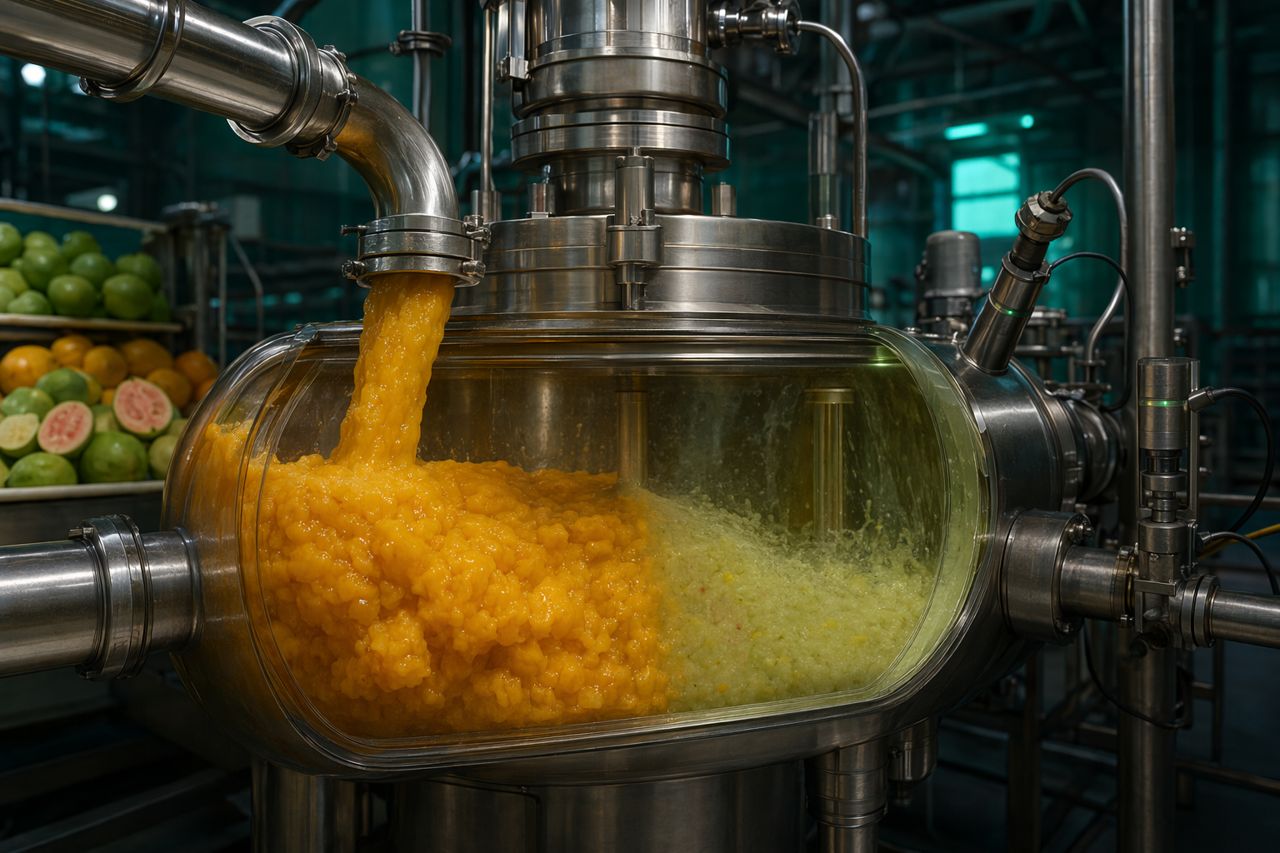
In many tropical fruits, pectin holds water, stabilizes suspended solids, and increases mash viscosity. If pectin is only partially degraded, the process can sit in an awkward middle zone: the mash may look more fluid, but fine solids and colloidal material still pass forward and overload clarification or filtration.
That creates a familiar pattern in production:
- Mash flows better after treatment.
- Press yield improves slightly, but not consistently.
- Turbidity remains high or unstable.
- Filters blind early.
- The plant adds more filtration time or cleaning time to protect final quality.
A better enzyme program targets the separation behavior of the whole stream, not just visible thinning.
Milling can create a filtration problem before enzymes are added
Aggressive milling increases surface area and can improve extraction, but it can also generate excess fines. In guava, mango, and passion fruit preparations, too much particle breakdown can increase the burden on downstream equipment.
If milling is too coarse, enzyme access may be limited. If milling is too aggressive, the plant may create a high-fines slurry that is difficult to clarify. The practical target is not maximum breakdown. It is controlled disintegration that allows enzyme access while avoiding unnecessary filter load.
For plant managers, the key question is simple: is the mill preparing the fruit for extraction, or is it creating solids the filter must later fight?
Enzyme treatment must match residence time and temperature reality
Many filtration bottlenecks trace back to a mismatch between the intended enzyme step and the actual plant condition.
Check the practical variables:
- Is the enzyme added where it can disperse evenly into the mash?
- Is the pulp temperature stable enough for predictable performance?
- Is the holding time real, or shortened by production pressure?
- Is mixing sufficient without excessive shear?
- Does the same treatment work across early-season and late-season fruit?
- Is the enzyme step designed for mash treatment, juice treatment, or both?
A treatment that looks correct on a process sheet may underperform if the dosing point, hold tank geometry, recirculation pattern, or batch timing prevents full contact.
Solids load determines what the filter is being asked to do
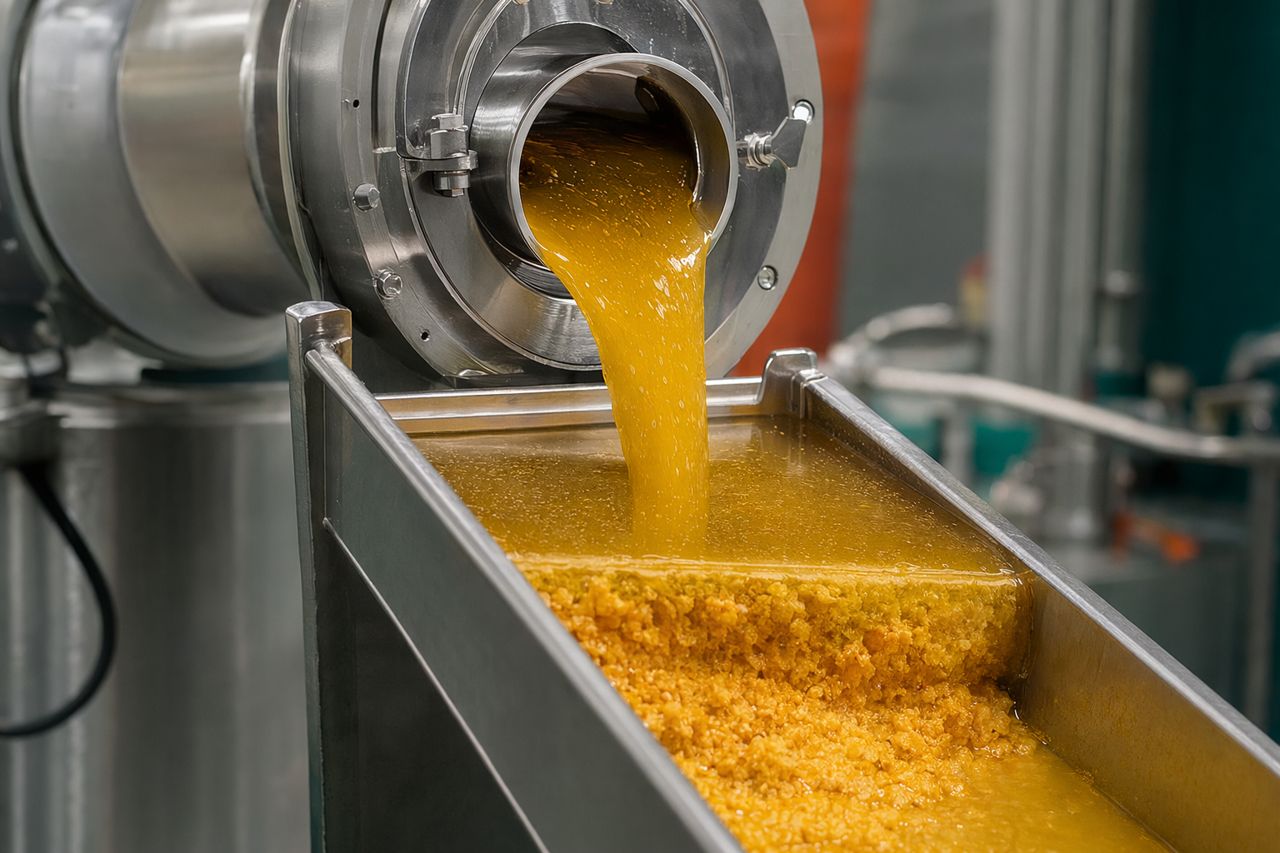
Filters are not designed to correct every upstream inconsistency. If press operation, decanter performance, or settling behavior shifts, the filtration system receives a moving target.
A plant may describe the issue as haze control, but the operational issue is often total load: insoluble solids, colloidal pectin fragments, suspended fiber, seed particles, and unstable fine pulp. Enzyme selection can help reduce viscosity and improve solids release, but it must be integrated with mechanical separation.
The strongest filtration outcomes usually come from aligning three controls:
- Enzyme action that reduces viscosity and destabilizes haze-forming structures
- Mechanical separation that removes released solids efficiently
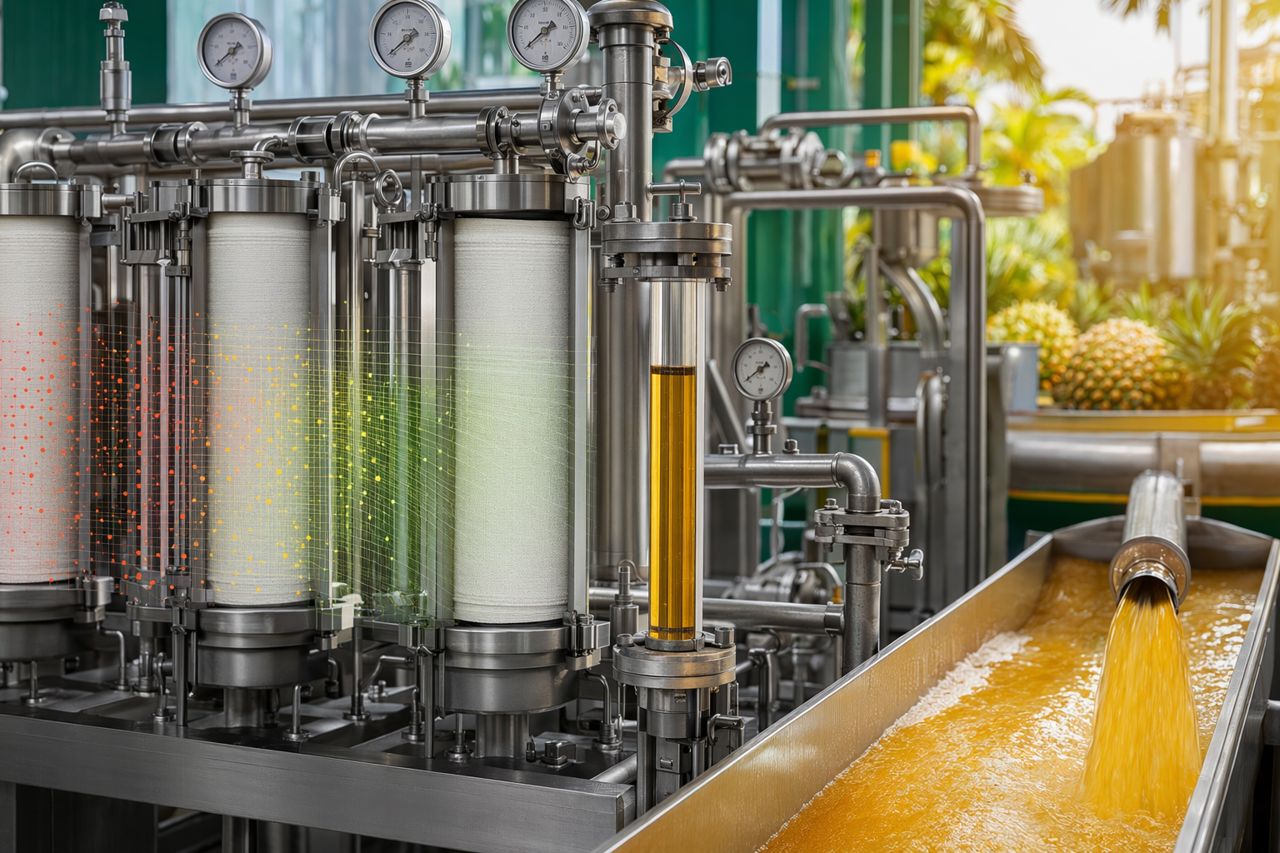
- Filtration that polishes a more consistent feed instead of carrying the full burden
Haze control is a process consistency issue
Haze is not only a quality concern. It is a throughput issue. When haze-forming material is still present, filtration becomes slower, filter media life shortens, and final product checks may delay release.
In tropical juice production, haze can come from several sources:
- Pectin and pectin-protein interactions
- Fine fruit fiber
- Starch or starch-like material in certain fruit streams
- Suspended seed and peel particles
- Incomplete clarification before final filtration
- Temperature shifts that change solubility and stability
The right enzyme program depends on the fruit, target product, and process layout. Mango nectar is not treated the same way as clarified pineapple juice. Guava pulp is not managed like passion fruit serum. Mixed-fruit operations need a strategy that tolerates raw material variation without forcing constant operator adjustment.
Where Enzymeforjuice focuses the trial
Enzymeforjuice supports plants as an enzyme supplier for fruit juice processing with a production-led approach. The point is not to sell a generic additive. The point is to reduce the specific constraint that is costing capacity.
A useful plant trial should be built around operating outcomes such as:
- Mash viscosity reduction before pressing
- Press yield and retained solids behavior
- Clarification speed after enzyme treatment
- Turbidity trend into and out of filtration
- Filter run length before cleaning or changeover
- Batch-to-batch repeatability across fruit variation
- Downtime linked to blinding, cleaning, and rework
We help define the enzyme application point, treatment window, mixing expectation, and validation plan so the plant can compare treated and untreated runs against practical production data.
Signs your filtration problem should be investigated upstream
Consider an upstream enzyme review if your plant sees any of the following:
- The same filter performs well on one fruit lot and poorly on the next
- Operators increase hold time or slow flow to protect clarity
- Filter media costs are rising without a clear mechanical fault
- Clarifier discharge looks heavier or more variable than expected
- Press cake remains wet even after process adjustments
- Juice appears clear after separation but develops haze later
- Cleaning frequency has increased while output targets stay the same
These are not just quality signals. They are capacity signals.
Build haze control into the process, not at the end
The most reliable tropical juice lines do not rely on final filtration to rescue the batch. They condition the mash early, separate solids efficiently, and send a cleaner, more predictable feed forward.
For plant teams, that means enzyme selection should be tied to the real bottleneck:
- If pressing is slow, focus on mash viscosity and pulp breakdown.
- If clarification is slow, focus on pectin condition and solids release.
- If filters blind early, focus on upstream fines, colloids, and separation load.
- If batches vary, focus on treatment robustness across fruit maturity and solids variation.
A small upstream mismatch can become a large filtration delay. Correcting that mismatch can release capacity without major equipment changes.
Request a quote for a plant-specific enzyme recommendation
If filtration load, haze instability, or slow clarification is limiting your tropical fruit juice line, Enzymeforjuice can help scope an enzyme solution around your process conditions and production goals.
Share the fruit type, process flow, bottleneck point, treatment step, temperature range, holding time, and the performance target you need to improve.
Request a quote for a plant-specific enzyme recommendation and supply proposal.